Saturday, January 11, 2020

"Our world could use this beauty; just think what we might do."


How do you decide what to say at your mother's funeral? I sat at desk, looking at a blank page, trying to think. Should I try to summarize my mother's life? Try to say what she meant to her family? Or should I instead offer some comfort to my grieving relatives? How would I begin to accomplish any of those goals? I prided myself on my ability to write about almost any subject. But here, with this assignment, I was at a loss.

I tried not to force anything. Instead, I allowed ideas steep in my mind, mixing around gently, letting them flavor my thinking like tea leaves sitting in water. Tea, I considered, was something that Mom and I both loved. We also shared a love of music, and I smiled to myself, remembering long drives listening to the radio together. As a kid I remembered telling Mom how terrible I though Joe Cocker was, how I didn't see how she could like his music at all. I remembered the time years later when I apologized to her for my youthful arrogance, because damn does that man pour his heart and soul into every single thing he sings. I remembered taking a walk with my parents one day, shutting down Mom's insistence that original songs were always better then covers with four words: "All Along the Watchtower". We both laughed, agreeing that my argument was irrefutable.

I remembered many other times that Mom and I had laughed together: the strange inside jokes we shared in the family, the awful puns that were so bad they were good again. I thought how she always shared her humor and good cheer with everyone, from Nobel prize-winning scientists to the children she taught in Sunday School. This reminded me of her selflessness, how she might be the only person I have ever known that would literally give you the shirt off her back if she thought you needed it. I reflected that she did her best to pass on all of these qualities to me -- humor, compassion, selflessness, love.

My mom passed away five years ago, but I'm still learning from her. I still try to follow her example. I don't dwell on the fact that she is gone; I try to let her life inspire me, to serve as a guide for becoming a better person. Planning her funeral, I realized I had to make a decision. I could look back with regret and sorrow, dwelling on my loss, grieving for all the things that I can't share with her and all the plans that cannot now be fulfilled. Or I could look forward, to see the influence of her life and her example, to see all of the wonderful things she gave to the world.

Death comes for us all. Ultimately, we own nothing, we hold onto nothing. We merely borrow substance for a while, using it for a while before inevitably returning it back to the Universe. As much time stretches before our birth as after we die. But, though our time and the very atoms that make up our bodies and minds are temporary, we still exert influence. We create ripples, we change the world by moving through it. General Choi, the founder of Taekwon-Do, implores martial arts students to "Be the eternal teacher who teaches with the body when young, with words when old, and by moral precept even after death."

In the end, I memorialized my mother by telling her favorite joke, by encouraging everyone gathered at her funeral to remember and share all of the fantastic times we had together -- and by re-dedicating myself to to moving forward, following her example and using everything she gave me in whatever new challenges and opportunities are ahead.

Addendum: as I was writing this essay, I heard the news that another of my lifelong heroes, Neil Peart, also passed away. His lyrics provide a fitting coda, and a reminder that we should never give ourselves over to regret or remorse.

All the journeys of this great adventure
It didn't always feel that way
I wouldn't trade them because I made them
The best I could, and that's enough to say

Some days were dark
I wish that I could live it all again
Some nights were bright
I wish that I could live it all again

- Neil Peart, "Headlong Flight"

Sunday, July 28, 2019

Into the Wind

A few days ago I was busy making polite, logical arguments, backed up by references -- and completely wasting my time. Over the Independence Day holiday, my Representative had stated a desire "to lead with the love of our Lord and teachings of Jesus Christ" while continuing to defend President Trump's inhumane border policies and overt racism. Reading these statements on her official Facebook page, I entered fray.


Of course, as my spouse was quick to point out, this proved to be futile, and served only to make me more frustrated and annoyed. It didn't matter how polite and courteous I was, it didn't matter how much I backed up my arguments with facts -- nobody responded to genuine questions I raised. I was met with contempt, juvenile insults, and non sequiturs -- but not a single person engaged with the ethical questions, hypocritical behavior, or policy outcomes I pointed out. The more I tried to engage in constructive discussion, the worse it got. I was derided as an elitist and had my faith questioned, but I never did find anyone willing to work with me toward common ground, or even engage with facts and reason.

The more I tried, the more annoyed and frustrated I became. "Why can't these people be consistent? Why does everybody make personal attacks, instead of poking holes in my reasoning? Why do I feel like I'm losing when all the facts are on my side?"

And then I read something from Meditations:
"As Plato said, every soul is deprived of truth against its will. The same holds true for justice, self-control, goodwill to others, and every similar virtue. It's essential to constantly keep this in your mind, for it will make you more gentle to all." -- Marcus Aurelius, Meditations, 7.63
These people that I see as antagonists and opponents are still people, just like me -- they want what's best for their families, their communities, their country -- but they are starting from a different place. They don't have my experiences, they haven't read the books I've read, they never sat at the kitchen table with my grandma or heard the personal history of racism from my Aunt Carrie.

It's easy to dismiss people who disagree with you as ignorant. It's easy to get caught up in the melee of debate -- to feel like there are sides, where for one team to win the other has to lose. It's much harder to remember that perceived "opponents" are starting from a different place. They have different experiences, they are seeing things from different places. Sure, there are genuine racists, people who sincerely think that stripping children from their parents isn't a complete moral failing, people with whom you'll never be able to find common ground. But much more often, people that seem to be your antagonists are being lied to and manipulated by the very people they are supporting; they're being conned.

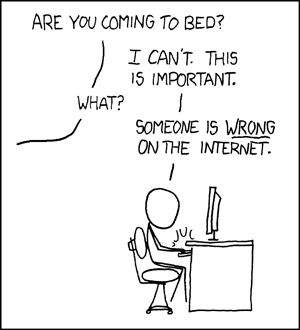
It is up to all of us to remember the Emperor's words, to strive to be gentle and compassionate and understanding, even with people that appear, at first glance, to be against us. They're starting from a different place, and being deprived of truth and justice against their will, perhaps without even knowing that those things are being stolen from them. Don't get drawn into pointless online debates, don't keep consuming news that only serves to stoke your anger, and don't double down just because "someone is wrong on the Internet." Remember who the enemy is, and who it is not.

Sunday, January 20, 2019

Looking in the Mirror

This week Gillette published an advertisement that made the polite suggestion that men should consider working toward being better people and treating everyone with dignity and respect. And while I'm sure that someone at the corporation crunched numbers and concluded that aligning themselves with current social trends would be good for the bottom line, I also don't have any reason to think that the sentiment on display wasn't a genuine reflection of the company's values. Many people seemed to like it; one friend of mine called it, "Powerful." But of course, the video also got some (rather predictable) people so upset they had to complain about it on the Internet.


I thought I might write some sort of impassioned response to this backlash. Perhaps I would describe how I'm raising my sons to be strong men, and what I mean by that phrase. Maybe I would write about the implications of "courtesy" being the first tenet of the martial art I've practiced for over two decades. Or I could dive into the fundamental insecurities and paranoia of "men's rights activists" (a phrase I continue to find hilarious), or discuss how those fears make them easy targets for manipulation.

The more I considered it, however, the less I found I had to say. If you find an advertisement that gently suggests men should treat women as equals offensive, perhaps you're part of the problem. If you are enraged when a company states that it would be a good idea to teach your kids empathy, perhaps you have more problems than your choice of grooming product. If you find that society continuing to move (however slowly) toward more inclusion, respect, and equality is a scary prospect, you should take a good, hard look at yourself in the mirror and consider why that might be. Perhaps you could do it when you're shaving.

In the end, my reaction to anyone offended by this advertisement was a mix of two things: contempt for those who consider their ability to engage in ignorant, misogynistic behavior a central part of their identity, and pity that they are unable to find the courage to change when it's pointed out.

Sunday, January 6, 2019

Thoughts for the New Year


Photo by NordWood Themes on Unsplash

2019 is here, and with the new year many people — myself included — are making plans, renewing commitments to goals, and generally figuring out what we will be doing for the next twelve months. Many people found the election of Donald Trump a call to action. I soon found like-minded people, banded together with them to resist the ignorance and greed now on display. We called our elected officials, argued with and attempted to persuade their staff, protested in the streets. We voted. We accomplished a great deal in the last two years, but we go into 2019 with much more to do. As I contemplate my own goals for the year, there are a few things that those of us who style ourselves as “The Resistance” should keep in mind.

Self care

First, take care of yourself physically. Do those things that you know you should — diet, exercise, sleep, meditate, or something else you think will improve your well-being. It is shocking how small changes can yield large benefits. If you wear down physically, it will hinder every other goal you have. If you push yourself to the breaking point, you will no longer be able to help anyone else.

Look for the good

Similarly, take care of your mental outlook. Actively look for the good things in life. Practice seeing them, every day, large or small. Consider keeping a gratitude journal — literally writing down things from your day for which you are grateful. Taking note every day of the good in the world trains you mentally to see more of them. The news seems constantly full of things that are infuriating, frightening, or both. Combat that seemingly endless onslaught of terrible events by practicing looking for the good.

Remember why we fight

We are part of a struggle, but be mindful of why it is that we are putting in that effort. Remember what we're struggling for; don't dwell on the fight, but remind yourself of the people, the ideals that are worth the effort. Don’t get sucked into reading or watching the news constantly, obsessing over every detail, every tactic, every thrust or parry. Be engaged, but remind yourself why that engagement is important. The struggle is not an end unto itself.

Attack ideas, not people

The clash of ideas and values is certainly real, but be mindful of not demonizing those you see as antagonists. Remember that everyone comes from different backgrounds and has different information. People "on the other side" are making choices and attempting to balance multiple — and often, conflicting — priorities, just as you are. They may be making decisions based on lies, propaganda, and manipulation. Don’t give into the temptation to see people who disagree with you (or seem to) as “the enemy”. Attack ideas, not people.

Stay positive

There is a lot of ugliness in the world right now; but as anger and fear are stoked, contrasts become more clear. Use all of the negative things you see as motivation to improve yourself, and redouble your commitment to your ideals.
  • If you are shocked at the willful ignorance of Donald Trump, strive to be informed, and to constantly question and re-evaluate what you think.
  • If you are outraged at the greed of the Trump administration, use that to be motivate more generosity.
  • If you are repulsed at the misogyny, the bigotry, and the brutishness of the President, bend your words and actions towards greater compassion.
  • If you find the fear and cowardice of Donald Trump contemptible, respond with strength, fortitude, and resolve.
Here’s to a better 2019. Resist.

Sunday, November 18, 2018

Republicans and Flat-Earthers

One of my work-study jobs in college was in the school’s planetarium. I have fond memories of the hours spent masking and re-arranging slides, making changes to the dome while listening to Frank Zappa on the planetarium sound system, and preparing presentations about astronomy and cosmology for the general public. I was excited, and a bit nervous, the first time I got to host a show. As people from the town started to file in the first night, I greeted each of them, chatting a bit and answering questions. As I welcomed our audience, I saw one man in line with a stack of papers and books under his arm. Dr. Lightner, the professor that managed the planetarium, also took notice, and asked me to start working the other side of the room as he went over to speak to him. “I’ll talk to you later about it,” he said. It was an unusual exchange, but I figured that it was an old colleague of his and didn’t think too much of it.

The show went well, but the exchange still lingered in my mind, and afterwards I asked about the man with all of the paperwork. I wondered if perhaps I’d said or done something wrong during the show. “No, no,” Dr. Lightner assured me. “You were fine — it’s just that I’d seen that gentleman before.” The man in question was some sort of flat-earth or fringe-science conspiracy theorist, apparently. “I didn’t want you to be bothered with him. He comes in occasionally trying to get people in the physics department to engage with his . . . ideas.” He was clearly trying to be diplomatic. “Nothing you could have said would have made a difference to him, no matter how well you stated it or what facts or reasoning you used. It just would have wasted your time.”

With its complete acceptance of Donald Trump, engaging with the Republican Party in 2018 is just as useful as trying to discuss astronomy with a flat-earther, as valuable as discussing geology or evolutionary biology with a young-earth creationist.

Many writers and commentators (including self-identified conservatives such as Jennifer Rubin and Max Boot) have already articulated what is self-evident -- the GOP has become the Party of Trump. The Republican Party of 2018 trades in conspiracy theories, fear, paranoia, and outright, blatant racism without even the semblance of shame.

During the presidential campaign of 2012, John McCain famously -- and courageously -- corrected his own supporter, pushing back against the suggestion that President Obama was a secret Muslim born in Kenya. "He’s a decent, family man — citizen — that I just happen to have disagreements with on fundamental issues,” he said. In contrast, Donald Trump started his political career by being the flag-bearer of the absurd, racist "birther" conspiracy theory, and his lies and racism since then have not only continued, but increased.

The Republican Party stands idle while children are forced from their parents. They support Supreme Court justices that display a pathetic lack of self control and self-discipline while doing their best to sweep concerns of women away. They do nothing while the head of state for our country genuflects toward despots and openly hostile foreign powers, believing their thinly-veiled lies over our nation’s intelligence services. The phrase "very fine people" is now in the common lexicon as code for tacit support of Nazism and white supremacy, thanks to the President. Each time Donald Trump blatantly lies or does something that is universally viewed as ignorant, short-sighted, or illegal, the GOP response has been either one of conspicuous silence or outright support. The few that seem willing to stand up for the most basic of values -- not the least of which are logic and objective facts -- have been either been berated into submission or lost primary elections to challengers that have swallowed the Trump groupthink hook, line, and sinker.

For Rep. Nancy Pelosi or anyone else that claims to want to "work in a bipartisan manner" or "reach across the aisle" I have one question: how the hell do you think you can do that when the Republican Party has systemically decided to be irrational?

I wish there was a political party that could engage in constructive debate with Democrats, a party that could push back, challenge ideas, and propose new directions. I wish we had a party that could take an honest, objective look at the obstacles and pain Americans are experiencing right now and offer real, practical solutions. I wish the Republican Party of 2018 was still attempting to uphold what Eliot Cohen lists as its historical values: "responsibility, stoicism, self-control, frugality, fidelity, decorum, honor, character, independence, and integrity". To my disappointment and their great shame, the GOP has deliberately, consciously abandoned all of that.

Unless I see Republican politicians publicly, vocally denounce the lawlessness, immorality, and active, continual deceit of Donald Trump and his administration, I cannot view them as acting in good faith. Until they choose to act against the recklessness and criminality of this administration, I see no reason to value anything they say any more than I could debate or compromise with someone who thinks the earth is flat.

Monday, April 2, 2018

Remembering Lessons from College

One afternoon in my junior year of college, I found out that The Princeton Review had named my school one of the top ten most homophobic colleges in the country. Furious, I spent the next hour reading everything I could about this survey. What methodology did they use? Did they just phone up a few drunken frat boys? What was the publication’s history of covering things like this? Did they have some axe to grind, some ideological bent one way or the other?

I only stopped my search when I needed to go to class. The trees had begun to display fall colors, while the ivy climbing up the side of Old Main's stately bell tower was still a deep, verdant green. My picturesque campus barely registered on me, however; I marched with my head down, staring at the sidewalk, my mind churning. I was angry that someone could hurl such an insult at my school, a place I loved and respected despite its faults. Sure, the student body was more conservative than I was, but then, I was left of many people who thought of themselves as liberals. Our faculty were compassionate, dedicated, talented educators and academics; every day they provided not only knowledge to students, but the ability to think critically and make sound judgements. Graduates left as better people than when they entered. The campus aspired to all the ideals that made me want a liberal arts education in the first place.

And then I thought, “What if . . . what if I’m being naive and simplistic? What if I’ve been living in my little sheltered bubble, bouncing between my classes and my circle of friends, isolated from what the rest of campus really thinks? What if my fellow students really are this ignorant and hateful? What if the survey was an accurate reflection of my school? What if they’re right?”

With these thoughts still swirling in my mind, I walked by Dr. Barbara Faires, my department chair and a woman for whom I had immense respect as an educator. She spoke to me by name and said pleasantly, “How are you doing today?”

The rage and frustration that had been simmering boiled over at the question. “How am I?” I snapped. “I’m mad as hell! Did you see this BS in the Princeton Review? Can you believe that crap? There’s a college not 20 miles from where we stand that would probably kick you out if you’re gay! When did they do this study, exactly, and how? They do some weak phone survey with five or six people, and that’s supposed to reflect who we are?”

Somewhere in the middle of my rant I realized how discourteous I was being, the rudeness of my words. I was swearing and raving at a professor who had simply offered a passing courtesy. “I’m sorry, Dr. Faires,” I said, trying to make my voice even, walk back my outburst a bit, and regain some civility. “I’m just furious and disgusted at the whole thing.”

She could have simply accepted my feeble attempt at apology and left it at that. Had she wanted to give me what I deserved, she would have been quite right to berate me, to tell me that I should mind my words and tone if I ever wanted a graduate school recommendation from her or any other faculty member. Instead, after listening to my raving, she said something I doubt I’ll ever forget.

“What do you think you’ll do about it?”

She didn’t chastise me for my rudeness. She didn’t brush off my outburst. She didn’t dismiss my anger or indignation.

What do you think you’ll do about it?

She said it calmly and with warmth, as though she we were both admiring the lovely fall weather around us.

What do you think you’ll do about it?

She hadn’t questioned if I should do something, or doubted my abilities. Her tone was without a hint of challenge, but I felt like she'd dropped something at my feet, daring me to pick it up.

What do you think you’ll do about it?

I’d been so caught up in my anger and righteous indignation, I hadn't given the possibility any thought. “I . . . I . . . I don’t know.” I stammered out, flailing about for a better response. But my rage had already been deflated. Dr. Faires wished me well and went on to her next appointment, leaving me with an entirely new set of questions and possibilities.

In the weeks that followed, I kept mulling over what my next step would be, keeping my ear to the ground for something that might provide direction. Soon, I discovered some like-minded people. I was not the only one furious about this slight to my school, not the only one looking for a way to take a stand for justice and compassion. We started to organize. I attended my first student government meeting, and walked out with funding for a new campus group that we named Allies. Westminster, for the first time, had an organization to support LGBT students. We sponsored lectures about biology, psychology, and sociology. We volunteered for local charities and raised money for non-profits. We staged events that made students and faculty pause and consider issues — consider people — in a new light. I even had a heartfelt conversation with my academic advisor about his family and the struggles he’d had reconciling his beliefs. Of all the things I did as an undergraduate, I am most proud of my work with Allies.

It’s been over a year since the election, and yet I’m still shocked every morning when someone uses the phrase “President Trump” in the news. Not a single week goes by without some juvenile outburst, a nonsensical statement masquerading as policy, or blatant lie from the White House, and so I remain angry and disappointed at the state of my nation. I wonder if my optimism and faith in my country is misplaced. I wonder if I should accept that Patton Oswalt was correct when he said the night of the election, "What I've learned so far tonight: America is WAAAAAAAAY more sexist than it is racist. And it's pretty fucking racist.” I’m searching for some way to reconcile the vision of what I think my nation can be with the daily reminder of how far away we still are.    

I’ve come together with like-minded people and become part of a sustained movement. We’ve called our congressmen, written letters, sat in their meetings. We’ve supported candidates that reflect our values. We’ve protected health care. We've protected our state parks from logging. We’ve gotten out in the streets and protested, again and again and again and again, demanding that we not be ignored, insisting that changes be made, showing them what democracy looks like.

Righteous anger is impotent unless it is combined with action, and the last year has reminded me that even the most basic things I had taken for granted must be continuously protected. Removed from my alma mater by tens of years and hundreds of miles, the lesson Dr. Faires taught me that day still echoes. She reminded me not only that determined, informed, consistent effort can and does change the world, but that I could be a part of that change.

The common good is under attack. The character of my nation is being debased and made the object of ridicule. Democratic principles -- and even basic facts -- I had long assumed were unassailable are under siege. Many of us have been complacent for too long. We are now left with a choice.

What do you think you’ll do about it?

Sunday, October 8, 2017

Thoughts on Charlottesville


Ever since a group of cowards flying Nazi flags killed someone in Charlottesville, I’ve been trying to write something. But then the President* goes and picks a fight with NFL players. And gets in an insult-trading contest with North Korea. And belittles the mayor of San Juan, while Puerto Rico continues to deal with the entire island being devastated. Something else terrible has probably happened in the time I've taken to write this. (Oh, look, I was right: https://www.nytimes.com/2017/10/08/us/richard-spencer-charlottesville.html)
What is it that gets the White House supporting people rocking the Confederate flag and chanting Nazi slogans, and then turn right around and demand that everyone has to jump up and put their hand over their heart every time they hear the Star Spangled Banner? (And, as comedian Trae Crowder points out better than anyone, the stars and bars may be the most inherently un-American symbol that exists.) Why is it that the Nazis who killed a woman in Charlottesville can be “very fine people,” but an athlete silently and respectfully trying to draw attention to violence and racism is a “son of a bitch”?
The common denominator is fear and cowardice. Punching down rather than punching up. Trump does nothing else. He began his run for the presidency by calling Mexicans rapists. He mocked people with physical disabilities during the campaign. He degrades and demeans women at every turn. His very entrance into politics was by leading the stupid and racist “birther” conspiracy.
Once in office, this behavior continued unabated, to the surprise of nobody who was even half conscious during the campaign. His foreign policy goes no deeper than juvenile name calling that I wouldn’t tolerate from my second graders. His domestic policy is the same, attacking everyone and everything but himself, while getting exactly nothing of substance accomplished. For a man holding the most powerful office in the world, Trump is remarkably thin skinned. It would be laughable, perhaps pitiable, if it weren’t so dangerous.
These Nazi douchebags in Charlottesville and elsewhere are the same way. The world white supremacists thought they were going to inherit didn’t turn out the way they expected. Change happens, and has always happened. But when faced with change — with the fact that the world was more complex and diverse and difficult than their fantasy 1950s America where the White Man was in charge of everything, women and blacks and gays knew their place, and All Was Right with the World — they lacked both the fortitude to adapt and the mental stamina to wrestle with facts that flew in the face of their pre-conceived notions. Instead, they lash out at everyone that doesn’t conform to their vision of the world. It would be laughable or pitiable if it wasn’t also dangerous.
White supremacists — note that I find this term completely interchangeable with “alt-right” — sell a vision where all problems are the fault of “the other”. The Jews control the money and the media, the blacks are causing all the crime, the Latinos are taking all the jobs, women demand that gender roles be challenged instead of keeping the house and children like they should be, and all of them together are bring about the downfall of civilization. They seem to have no ability whatsoever to either look inward or adapt to the actual world, or empathize with anyone who isn’t exactly like them. They revel in the past because they cannot bear the future. And they sell that vision to the gullible and the ignorant.
Introspection, or even just the ability to listen and attempt to understand someone else’s point of view, is apparently more effort than white supremacists are capable of mustering. So they retreat into their like-minded conclaves, where anyone with a slightly different skin tone can automatically be considered inferior, the burden of thought can be offloaded onto some charismatic leader who tells you what to think, and anything in society or culture that may break the illusion that they’ve cultivated is something to be dismissed or attacked. They continually steep and revel in their perceived victimhood.
Donald Trump may not be a card-carrying member of the Klan or alt-right, but he certainly seems to share their worldview. Everything revolves around him, and nothing is ever his fault. He campaigned by constantly blaming other people for society's ills, and won by duping enough people with his simplistic vision of the world. And, wittingly or not, he continues to enable and support the pathetic drivel coming out of these racist movements.
So, what do we do? How do we combat this level of ignorance and these vile ideas? As Lt. Gen. Jay Silveria pointed out at the Air Force Academy, you do it with a better idea. We do it by treating each other with dignity and respect.
The white supremacists continue to claim that diversity is the root of all of society's ills. They would have you believe that any attempt to wrestle with the uncomfortable past of the United States is an attack on history and heritage. (By the way, it's not.)They claim that in order for one group to win, all others must lose.
Well, I have a better idea. I claim that the diversity of the United States is our strength, and that while it has been a long, difficult struggle, we still move toward the ideal enshrined on the Great Seal of our country: e pluribus unum. We continue to have grave challenges to our nation: wealth inequality, systemic racism, fundamental changes in the global economy, climate change -- all of these, and more, threaten the foundations of our country. But when we find the courage to look at ourselves and the fortitude to change, these challenges -- and any others -- can be overcome.